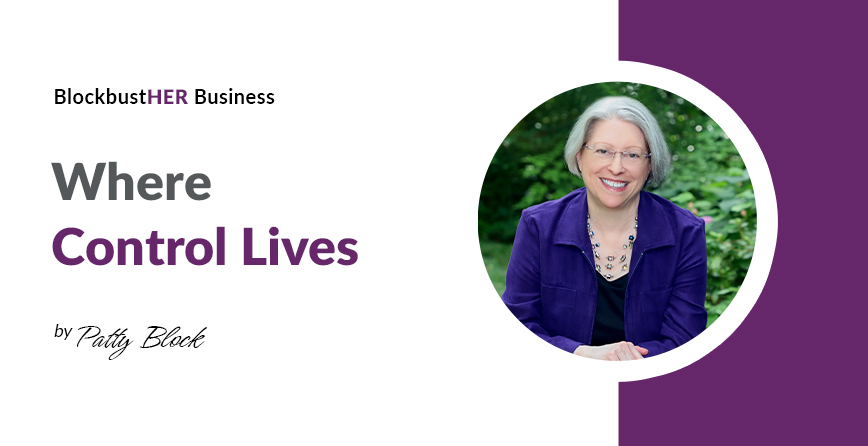
Where Control Lives
My first clue was Kiley describing her headaches.
They arrived every afternoon, right on cue—when her calendar became a solid wall of calls. Clients needing reassurance. Team members needing decisions. Advisors asking her to choose between options that all carried risk.
She joked about it at first. My body hates my business. But when she described the feeling more precisely, the joke fell apart...
Today’s BlockbustHER BrainteasHER:
Where are you exerting control to manage anxiety rather than outcomes?
Patty’s Perspective . . .
“It’s not pain,” she said. “It’s pressure. Like everything is pushing forward at once, and if I don’t stay ahead of it, something will break.”
She had done everything right. Built the firm carefully. Created optionality. Positioned herself so she could sell—or stay and extract value more cleanly. She had paths. Models. Advisors.
I asked her a question she wasn’t expecting: What are you trying to control that isn’t actually controllable?
She went quiet. Not thoughtful quiet—defensive quiet. “Everything,” she finally said. Then corrected herself. “Everyone.”
She was holding the business together with vigilance. Monitoring tone. Anticipating disappointment. Absorbing uncertainty so no one else had to. She believed—without ever naming it—that if she loosened her grip, the whole thing would tilt.
The headaches weren’t a mystery. They were the cost of pretending control was possible.
- The Elegant Exit™ provides two viable paths:
- Latent Capital™: selling, merging, or creating a deal that moves you out of the business.
The math can work IF you’re generating upwards of $5M annually, with consistent, predictable revenue. You have a strong leadership team. You’ve actively built real business value. And you have the patience and commitment to handle the emotional rollercoaster of the sales process.
- Living Capital™: extracting value from the business while you still own it.
This is not about passive income—it’s about portable power. Generally, this is a better fit for businesses generating less than $5M annually. Women who choose this path tend to be deeply loyal—to clients, teams, and the identities they’ve worn for decades. Their exit comes in the form of evolving and extracting.
When I defined these two paths, Kiley kept asking the same question in different forms: Which one is safer? Which one gives me more certainty?
Neither.
Both create freedom. Both build wealth. Both reduce stress. But they require different truths, different emotional muscles, and different definitions of ‘enough’.
Both paths offer agency—the chance to stop managing forces that will never respond to your effort and redirect energy toward what does.
- Control Is Psychological Before It’s Tactical
You’ve spent years making decisions that affect livelihoods, clients, and reputations. Of course you value control.
And then comes the exit process—an experience that seems engineered to test that instinct.
Many founders respond by gripping tighter. More involvement. More vigilance. More pressure on themselves to stay on top of everything.
But the most successful exits are led by founders who understand where control actually lives—and where it doesn’t.
Control is not about managing outcomes—it’s about managing decisions.
- What You Actually Control
- The moment you stop performing endurance.
- The moment you stop performing endurance.
Whether you decide to pursue Latent Capital™ or Living Capital™, you control the moment you stop believing stamina is a proxy for worth. The business doesn’t change overnight—but the internal contract does. That shift alone alters every decision that follows.
-
- How much of you the business is allowed to consume.
- How much of you the business is allowed to consume.
Kiley told me, “I thought staying meant staying the same.” It doesn’t. What she controlled was not the market or client demand, but how much of her identity revolved around the business.
-
- How you select your advisory bench.
- How you select your advisory bench.
This is one of the most underestimated levers in the exit process. Who you choose to advise you shapes how you think, what risks you see, and which compromises feel ‘reasonable.’
-
- What your narrative says about you and your team.
Not the spin—but the story. Why your business exists. Why now. Why this transition makes sense. A clear narrative anchors negotiations and steadies decision-making when emotions run high. The Elegant Exit™ is not about the move. It’s about who gets to define it.
- What You Don’t Control (and Shouldn’t Try To)
- How the market will interpret your value.
- How the market will interpret your value.
Business value is influenced by factors far beyond effort or merit. Over-identifying with valuation can turn a business transaction into a referendum on self-worth—an unnecessary and costly mistake.
If you pursue Latent Capital™, buyers will test boundaries, delay decisions, ask uncomfortable questions, and renegotiate late. Living Capital™ has its own challenges. Neither path guarantees validation.
-
- How unseeable forces move the needle.
- How unseeable forces move the needle.
Markets shift. Capital pauses. Internal buyer dynamics change. Founders who anchor emotionally to a specific closing date, timeline, or strategy often make concessions they later regret.
-
- Whether others agree with your choice.
- Whether others agree with your choice.
You cannot control how your path threatens someone else’s worldview. Kiley admitted, “The hardest part wasn’t choosing—it was letting people misunderstand me.”
-
- Most importantly, you do not control certainty.
- Most importantly, you do not control certainty.
Exits are probabilistic, not guaranteed. The sooner you accept this, the more rational—and resilient—your decisions become. Stop chasing the illusion of certainty—and start celebrating a life that can hold uncertainty without collapsing.
- The Power of Stepping Back
One of the hardest lessons for founders is knowing when to step back strategically.
This doesn’t mean disengaging. It means shifting from operator to architect. From executor to decision-maker.
In the end, the exit process is less about giving up control than redefining it. The question isn’t whether you’re in charge.
The question is whether you’re using control in service of the outcome you want—or the fear you’re trying to quiet.
Now What?
Imagine you’re walking on a dusty country road with long grass and beautiful wildflowers defining the path. The sun is shining, the sky is blue, and tiny birds are flittering all around. You hear their songs and feel the breeze ruffle your hair.
You’re going where you want to go, at the pace you want to travel. You’re in control.
Now, there’s a fork in that dusty road and it’s up to you to decide the path right for you.
I’m describing your business journey—sometimes beautiful, sometimes harsh, and always worth it.
The fork in the road is how you want to exit, because you will exit someday, whether it’s chosen or forced.
Exiting your business is complex and confounding. Since 2006, I’ve seen women get harassed, hurt, and hustled. All. The. Time.
That’s why I help women founders achieve an Elegant Exit™—because you deserve better.
An exit is elegant only if it increases your personal wealth while decreasing the stress required to maintain it.
Anything else is just endurance with better branding.
The Elegant Exit™ is how you convert business success into real wealth—without sacrificing your nervous system to get there.
As your advocate, I’m looking out for your best interests, guiding you to discover right-fit options, execute critical decisions, and cultivate personal wealth.
Contact me to learn more.
What are your biggest blind spots in crafting an exit? Find out at: http://she-exits.com/

A Note from Patty...
My life’s work is empowering high-achieving women business owners to fine-tune their operations and scale their revenue for strategic growth, creating real business value and emerging exit ready. That value can transform into wealth when they are ready to exit their company - and I believe that wealth in the hands of women elevates society as a whole.
Latest Articles
- Your Fork In The Road
- Living Capital™
- 3 Lies We're Sold
- Where Control Lives
- Not One-Size-Fits-All
- Cash is Queen
- The Partial Liquidity Path
- Your Wealth-Building Engine
- The Myth of ‘Someday’ Wealth
- Survival Isn’t Success
- Design Your Next Act First
- Strategic Scaffolding
- The Elastic Business
- When Profit Lies
- The Strategic 'No'

Your Hidden Advantage
Unlock the Power to Attract Right-fit Clients and Boost Your Revenue