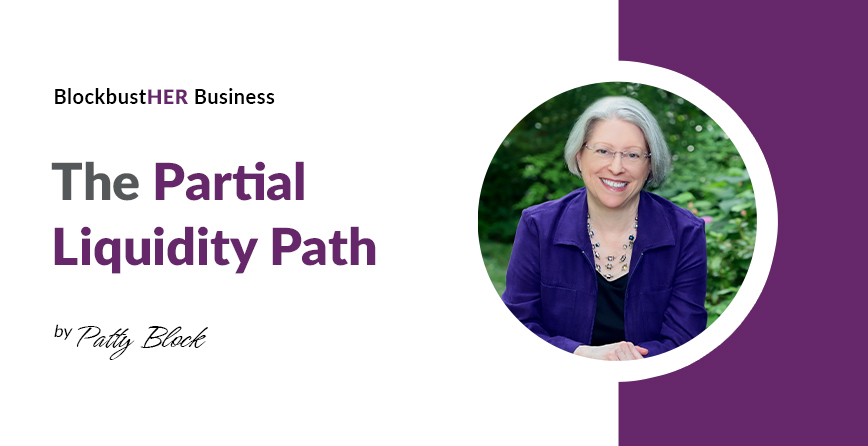
The Partial Liquidity Path
Maria used to believe there were only two kinds of founders: The ones who owned everything, and the ones who were already on their way out.
Anything in between felt like weakness. Indecision. A failure of nerve.
She built her firm over sixteen years—slowly, deliberately, with a reputation that preceded her into rooms she hadn’t even entered yet. Full ownership felt like proof. Control felt like safety.
What no one warned her about was the cost of carrying all the risk alone...
Today’s BlockbustHER BrainteasHER:
How would your decision-making change if some risks were already off the table?
Patty’s Perspective . . .
On paper, Maria’s business was successful. Profitable. Stable. Admired. But every decision carried an invisible tax.
If she invested, she alone absorbed the downside. If she didn’t, she alone carried the regret.
If something went wrong—market shift, client loss, her own exhaustion—there was no buffer.
Total ownership wasn’t freedom. It was exposure.
She told herself this was what leadership looked like: holding it all, managing it all, being responsible for everything. The pride was real. So was the quiet anxiety that hummed beneath it.
Maria didn’t want to sell. She just wanted to stop feeling like one misstep could unravel her future.
- Selling Without Vanishing
When Maria sold a minority stake, people didn’t know what to make of it. Was she cashing out? Was she preparing to exit? Was she losing control?
The truth was far less dramatic—and far more powerful.
She stayed CEO. She kept her voice. She retained decision rights over the things that mattered most. But she converted a portion of hypothetical future value into something tangible, present, and calming.
The money itself wasn’t extravagant. What it bought was optionality.
She no longer made decisions with the weight of ‘this has to work’ hanging over them. She could invest thoughtfully. Decline opportunities that weren’t aligned. Think longer-term precisely because her short-term security wasn’t on the line.
Partial liquidity didn’t dilute her power. It stabilized it.
- Why This Model Feels So Uncomfortable
Women are often taught that ownership is binary: you’re either in control or you’re not. That any compromise is a step toward irrelevance.
But this model exposes a deeper truth: Control without liquidity is fragile.
The idea that wealth only counts once it’s realized at a sale ignores the reality of time, health, and human limits. Partial liquidity acknowledges that life is happening now—not after a transaction, not after a perfect exit, not after one more year of grinding it out.
This path doesn’t appeal to ego. It appeals to wisdom.
Partial liquidity isn’t about hedging. It’s about acknowledging reality: that businesses are long, uncertain journeys. That women’s lives are complex and non-linear. That tying all reward to a single future event is not courage—it’s concentration of risk.
That’s a different kind of power.
Now What?
Exiting your business is complex and confounding. Since 2006, I’ve seen women get harassed, hurt, and hustled. All. The. Time.
That’s why I help women founders achieve an Elegant Exit™—because you deserve better.
My research and decades of experience now have me challenging the basic premise of building wealth through a business sale. Not because selling isn’t certain—because it’s contingent.
The truth is the Elegant Exit™ provides two viable paths: Latent Capital™ or Living Capital™.
Both create freedom. Both build wealth. Both reduce stress. But they require different truths, different emotional muscles, and different definitions of ‘enough’.
- Latent Capital™: selling, merging, or creating a deal that moves you out of the business.
The math can work IF you’re generating upwards of $5M annually, with consistent, predictable revenue. You have a strong leadership team. You’ve actively built real business value. And you have the patience and commitment to handle the emotional rollercoaster of the sales process.
2. Living Capital™: extracting value from the business while you still own it.
This is not about passive income—it’s about portable power. Generally, this is a better fit for businesses generating less than $5M annually. Women who choose this path tend to be deeply loyal—to clients, teams, and the identities they’ve worn for decades. Their exit comes in the form of evolving and extracting.
An exit is elegant only if it increases your personal wealth while decreasing the stress required to maintain it.
Anything else is just endurance with better branding.
The Elegant Exit™ is how you convert business success into real wealth—without sacrificing your nervous system to get there.
The true power is not choosing the right strategy—but finally asking the right questions:
- How do you want to live while the business is still yours?
- How much of your current strategy is built on someone else’s definition of your success?
- Are you designing a transition—or waiting until illness or exhaustion decide for you?
When women choose their path—truly choose it—something surprising and exquisite happens.
The noise disappears. The constant internal negotiation—the second-guessing, the ‘should I be doing more’, the quiet dread that you’re missing the right move—goes silent. What replaces it is not certainty, but consent.
You are no longer bracing for the future or apologizing for the present. Wealth—however it arrives—stops feeling conditional.
And in that quiet, you discover that decisions become cleaner. Time stretches. The business no longer feels like a test you must pass, but a tool you are finally allowed to use.
That’s the power of your Elegant Exit™ when the right expert is by your side. As your advocate, I’m looking out for your best interests, guiding you to discover right-fit options, execute critical decisions, and cultivate personal wealth.
Contact me to learn more.
What are your biggest blind spots in crafting an exit? Find out at: http://she-exits.com/

A Note from Patty...
My life’s work is empowering high-achieving women business owners to fine-tune their operations and scale their revenue for strategic growth, creating real business value and emerging exit ready. That value can transform into wealth when they are ready to exit their company - and I believe that wealth in the hands of women elevates society as a whole.
Latest Articles
- Your Fork In The Road
- Living Capital™
- 3 Lies We're Sold
- Where Control Lives
- Not One-Size-Fits-All
- Cash is Queen
- The Partial Liquidity Path
- Your Wealth-Building Engine
- The Myth of ‘Someday’ Wealth
- Survival Isn’t Success
- Design Your Next Act First
- Strategic Scaffolding
- The Elastic Business
- When Profit Lies
- The Strategic 'No'

Your Hidden Advantage
Unlock the Power to Attract Right-fit Clients and Boost Your Revenue